
Pinglu Canal bridges southwest China's final link to the sea
Source:CCCCTime:2026-09-24
The core value of the Pinglu Canal, built with CCCC's participation, lies in a single word: "connectivity."
The core value of the Pinglu Canal, built with CCCC's participation, lies in a single word: "connectivity." Wu Peng, chief technical lead for the canal's overall design and a National Engineering Survey and Design Master, offers an in-depth explanation of why the Pinglu Canal is regarded as the key project unlocking the "last mile" of water transport in Southwest China.
It works like three keys, unlocking geography, technology, and logistics in turn — each breakthrough opening the way to a broader future.
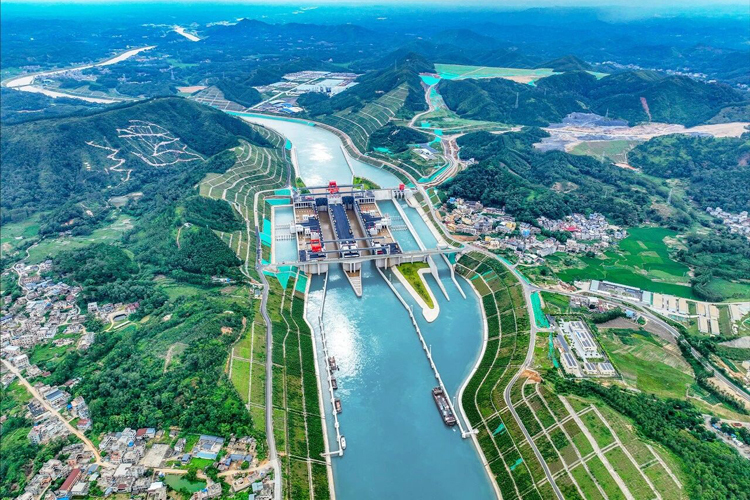
The first key unlocks geography: The canal cuts through the watershed to join the Qinjiang River and reach Beibu Gulf directly. The voyage from Nanning to Beibu Gulf Port is shortened to 240 kilometers, saving seven days of shipping time. Bulk cargo from Southwest China no longer needs to detour through the Pearl River Delta, delivering immediate cost savings.
The second key unlocks technology: The Madao Junction is home to the world's largest and highest-head inland water-saving ship lock. Engineers pioneered a "three-tier stacked" water-saving pool system, storing and recycling water through the chambers. Valve operation speed has increased several times over, achieving a world-class standard of completing water transfer in just 15 minutes.
The third key unlocks logistics: Lower logistics costs are reshaping where industries choose to locate, forming a vein-like industrial belt. Estimates show the canal could boost newly added GDP along its route by 130 to 200 billion yuan annually.
Three keys — breaking geographic barriers, overcoming engineering challenges, and unclogging development bottlenecks. The Pinglu Canal is not an endpoint, but a new starting point.
Editor: CCCC