
Dalian Bay Undersea Tunnel achieve new technical breakthroughs
Source:CCCCTime:2022-09-15
Using the sectional pipe jacking method, the final joint of pipe section E18 of the Dalian Bay Undersea Tunnel were successfully installed with precise docking.
Sectional pipe jacking method—The first case of final joint installation in China's immersed tunnel
Using the sectional pipe jacking method, the final joint of pipe section E18 of the Dalian Bay Undersea Tunnel were successfully installed with precise docking. The project verified the feasibility of the method and was the first of its kind in China, further consolidating CCCC's leading position in the field of immersed tunnels.

Dalian Bay Undersea Tunnel is the first cross-sea immersed tunnel in the cold northern region of China. The final joint is located between the E18 pipe section and the section on the south shore, which mainly consists of jacking section, external sleeve, waterproof structure, jacking device and locking structure. The jacking section is 5.75 meters long, weighing about 2,500 tons, and will be pushed out by four jacks with a maximum jacking force of about 300 tons in the external sleeve to finally realize the docking with the E18 section. The final joint installation accuracy reached the millimeter level.
The sectional pipe jacking method is the first of its kind proposed and applied in China. At present, the method has applied 15 patents, of which 8 have been granted.
Bring new ideas to the construction of anti-collision piers
In order to protect the project from the impact of ships, it is necessary to set up strong anti-collision piers around the immersed pipes.
Although the anti-collision pier is the most common structure in hydraulic engineering, the key to meet both the demand for anti-collision and marine environmental protection is that the anti-collision piers should have water permeability.
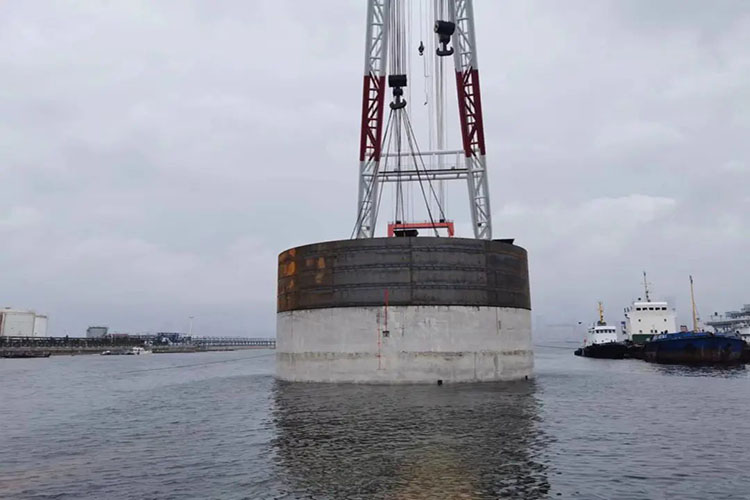
After repeated discussions, the project team finally determined the prefabricated caisson plan, that is, the construction of the anti-collision pier is divided into two parts, the upper retains the pile structure to meet the anti-collision and pier permeability requirements; the lower is optimized for as the caisson structure. In this way, the construction of the anti-collision piers does not need a marine platform, which improves the construction efficiency and reduces the safety risk of marine operations, which is the best solution.
The chief engineer exclaimed, "The optimization of the caisson brought new ideas for the construction of various anti-collision piers in the future."
Editor: First Harbor Engineering