
CCCC accelerates integration of marine energy and digital infrastructure
Source:CCCCTime:2026-06-05
Recently, the world's largest offshore converter station, "Hai Feng Zhi Xin," or "Heart of the Sea Wind," built by ZPMC, was shipped to the waters off Yangjiang, south China's Guangdong Province, marking the start of its offshore installation.
Recently, the world's largest offshore converter station, "Hai Feng Zhi Xin," or "Heart of the Sea Wind," built by ZPMC, was shipped to the waters off Yangjiang, south China's Guangdong Province, marking the start of its offshore installation.
Offshore converter stations are the central hubs for large-scale deep-sea wind power development. They convert alternating current from wind farms into direct current, significantly reducing transmission losses over long-distance subsea cables and enabling wind power to expand further into deep waters.
In recent years, ZPMC has been deeply engaged in the manufacturing of offshore wind power converter stations, delivering a series of landmark projects, including the Rudong offshore converter station in east China's Jiangsu Province—the largest of its kind in the world at the time and the first offshore wind power converter station in Asia. These projects have supported the transition of offshore wind power from rapid expansion to high-quality, sustainable development.
"Heart of the Sea Wind" is an eight-story steel platform measuring approximately 85.5 meters long, 82.5 meters wide, and 44 meters high, with a total weight of around 25,000 tonnes.
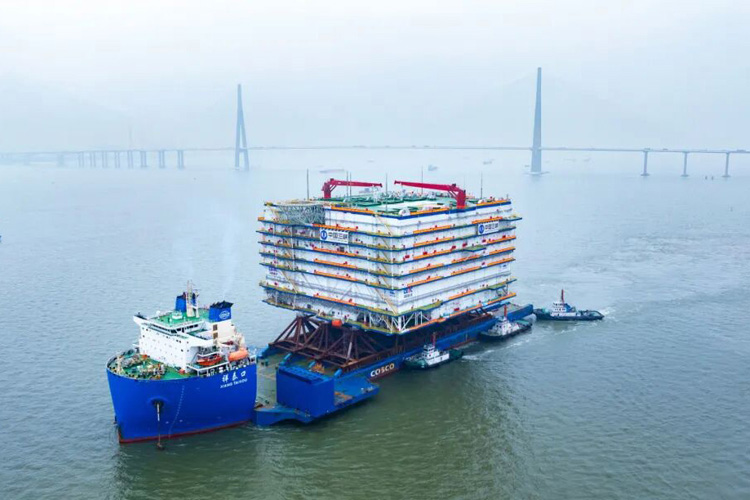
Photo shows the world's largest offshore converter station, "Hai Feng Zhi Xin" or "Heart of the Sea Wind," built by ZPMC.
The platform will serve the Three Gorges Yangjiang Qingzhou 5 and 7 offshore wind farms, projects that set six global records and established a global benchmark in offshore wind engineering. With a total installed capacity of 2,000 MW, the wind farms can generate roughly 6 billion kWh of clean electricity annually.
As cutting-edge industries such as artificial intelligence (AI) grow rapidly, data centers face two major challenges: strained power supplies and high freshwater consumption for cooling. In response, CCCC has pioneered an innovative approach—leveraging the sea for space and wind for power.
The recently commissioned world's first underwater data center powered mostly by offshore wind—the first phase of the Shanghai Lingang undersea data center demonstration project—demonstrates a deep integration of marine engineering, green energy, and digital infrastructure, creating a model for a new energy system.
The data center has a total capacity of 24 MW and relies on two core technologies: direct offshore wind connection and natural seawater cooling. Wind power is transmitted directly to the facility via subsea hybrid power and fiber-optic cables, while seawater naturally cools the equipment. Compared with traditional land-based data centers, it cuts electricity use by 22.8 percent, eliminates freshwater consumption entirely, and reduces land use by more than 90 percent.
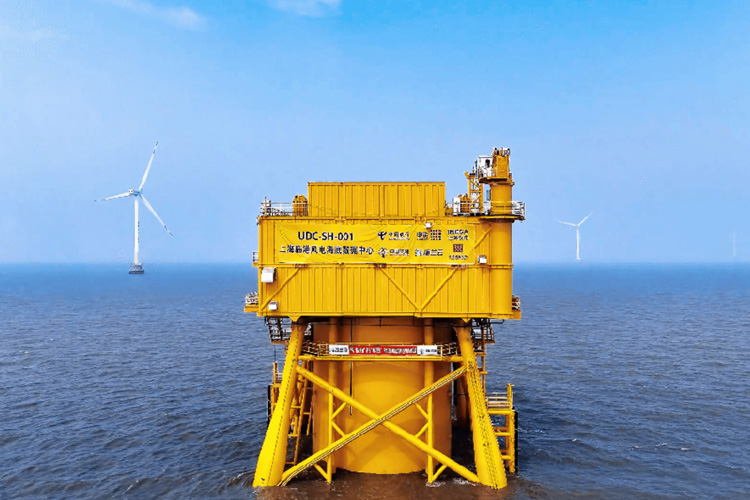
Photo shows the first phase of the Shanghai Lingang undersea data center demonstration project.
Now fully operational, the data center not only supports local AI industry upgrades but also offers a pioneering model for low-carbon, sustainable development in the global data center sector.
Editor: Third Harbor Engineering, ZPMC