
Shiziyang Grand Bridge to set 5 world records
Source:CCCCTime:2026-04-30
The successful progression of this mega-project comprehensively demonstrates CCCC's advanced engineering capabilities and unwavering commitment to driving regional infrastructure development.
Recently, the construction of the Shiziyang Link, a core hub project in the Guangdong-Hong Kong-Macao Greater Bay Area, achieved significant progress as both the 342-meter-high east and west main towers of the Shiziyang Bridge were successfully topped out.
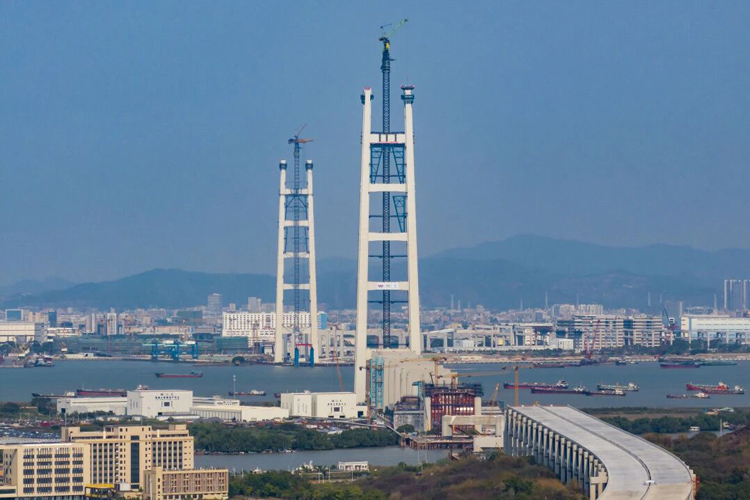
As the first double-deck cross-river highway at the Pearl River Estuary, the Shiziyang Link is located between the Nansha Bridge and the Humen Bridge. The project starts in Dagang Town, Guangzhou, and ends in Humen Town, Dongguan, approximately 38 kilometers away from the Shenzhen-Zhongshan Link.
Once completed, the Shiziyang Grand Bridge will set 5 world records: the longest main span for a double-deck suspension bridge, the highest main tower, the largest anchorage foundation diameter, the thickest main cable, and the largest number of traffic lanes. These achievements will mark a significant milestone in global bridge construction history.
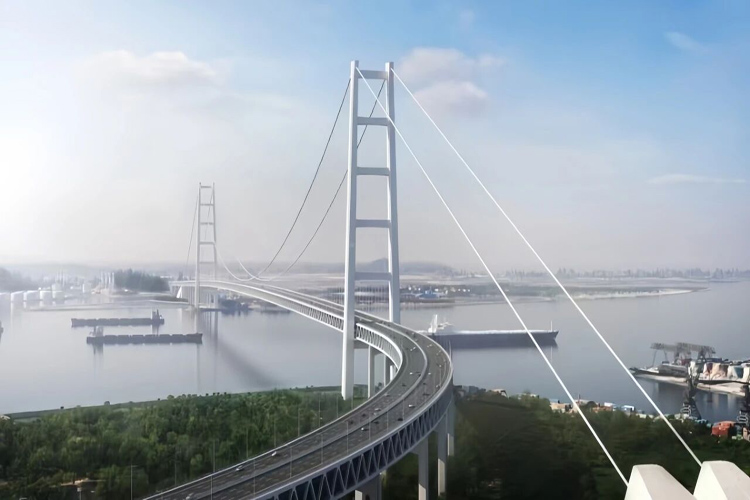
The bridge features a single span of 2,180 meters to cross the river, which preserves an unobstructed corridor for the golden waterway while maximizing efforts to minimize the ecological impact on the aquatic environment.
The dual-level, 16-lane layout effectively doubles the traffic capacity compared to traditional single-deck bridges, significantly improving regional connectivity and providing ample capacity for future traffic growth in the Greater Bay Area.
The world's largest mobile counterweight tower crane, R20000-720, developed by CCCC, is deployed to construct the 342-meter mega towers. Featuring a maximum lifting capacity of 720 tons, it can lift 500 cars at once. Furthermore, its intelligent system is equipped with 519 collision risk algorithms, ensuring millimeter-level precise lifting even under complex wind conditions.
To ensure the structural stability and resilience of the mega towers, the project team adopted an innovative steel-plate concrete composite structure for the bridge towers. Compared to traditional concrete towers, this innovative structure reduces concrete usage by 43%, resulting in a lighter yet stronger tower body.
The tower construction process is driven by smart construction systems, with every procedure and data point integrated into digital twin technology, ensuring that the entire construction process is fully visible and controllable.
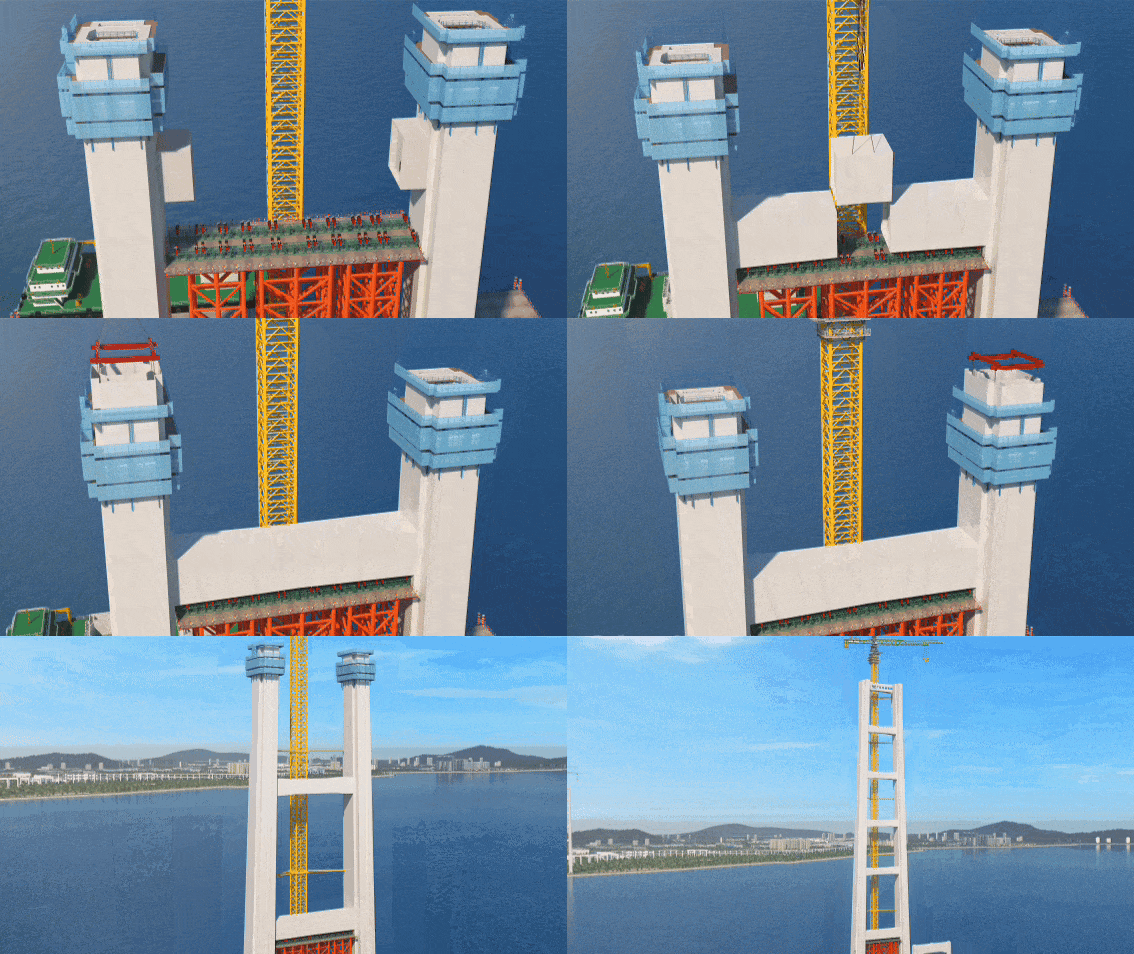
In addition, the crossbeam construction employs modular integrated lifting, which directly reduces construction time by 70%.
The successful progression of this mega-project comprehensively demonstrates CCCC's advanced engineering capabilities and unwavering commitment to driving regional infrastructure development.
Editor: Second Harbor Engineering